
FYTR / INSIGHTS
Why Recruitment Capacity Should Flex With Hiring Demand
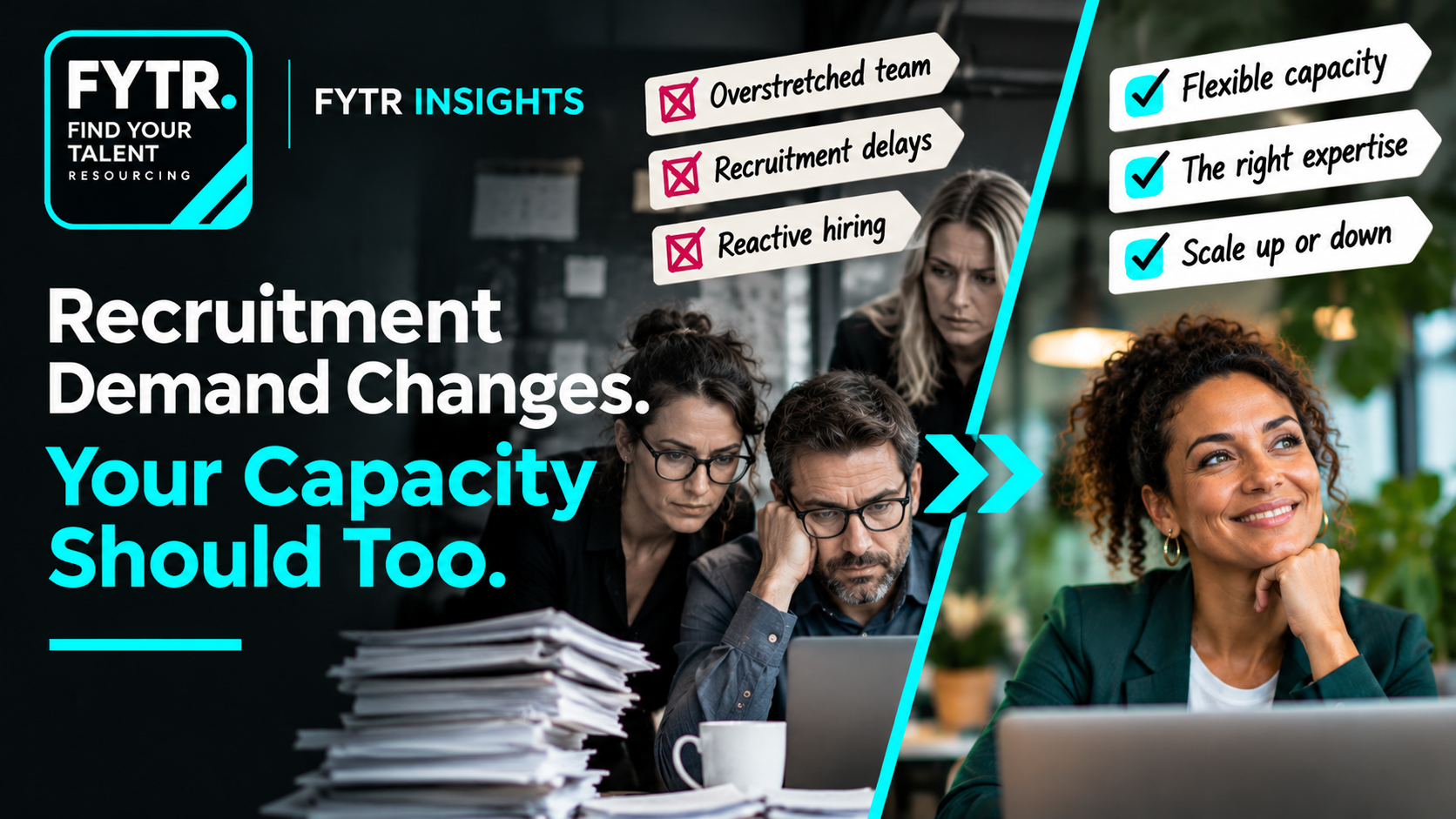
Businesses don’t recruit at the same rate every month. So why do we keep designing recruitment teams as though they do?
Recruitment demand is rarely predictable.
One quarter, an organisation might be recruiting steadily across a handful of departments. The next, a new contract, business expansion or unexpected turnover creates a sudden increase in vacancies.
Then, just as quickly, demand can fall.
Yet many organisations continue to structure their recruitment functions around relatively fixed resources.
They employ a set number of recruiters, establish annual recruitment budgets and expect those resources to absorb whatever hiring demand emerges.
When recruitment increases, teams become overstretched.
When recruitment slows, organisations can find themselves carrying capacity they no longer need.
It’s a familiar problem.
But perhaps we’re asking the wrong question.
Instead of asking how many recruiters an organisation needs, shouldn’t we be asking what recruitment work needs to be delivered, when, and by whom?
The Problem With Fixed Recruitment Capacity
Traditional workforce planning tends to focus on roles and headcount.
An organisation expects to recruit a certain number of people, estimates the workload and builds a recruitment team around that forecast.
That approach can work when demand is relatively stable.
But what happens when hiring volumes fluctuate significantly?
A team designed to manage 20 vacancies might suddenly find itself responsible for 60.
The immediate response is often to work harder, extend deadlines, bring in agencies or begin recruiting additional permanent talent acquisition professionals.
Yet each option introduces challenges.
Existing teams can become overwhelmed. Hiring managers experience delays. Candidate communication suffers.
And recruiting additional permanent staff takes time, sometimes longer than the period of increased demand itself.
The underlying issue isn’t necessarily the capability of the recruitment team.
It’s the assumption that recruitment capacity should remain fixed when recruitment demand doesn’t.
Recruitment Is a Collection of Activities, Not Just a Job Title
When organisations think about recruitment resources, they often think in terms of recruiters.
But recruitment involves many different activities, each requiring different capabilities and levels of expertise.
Consider a typical recruitment process:
- Understanding the vacancy and agreeing requirements
- Developing an attraction and sourcing strategy
- Advertising the opportunity
- Identifying and engaging potential candidates
- Screening applications
- Coordinating interviews
- Communicating with candidates and hiring managers
- Managing offers and recruitment administration
- Reporting on progress and outcomes
These activities don’t all require the same expertise.
Nor do they necessarily need to be delivered by the same person.
A senior talent acquisition professional might be highly effective at stakeholder management, recruitment strategy and specialist candidate engagement.
But if much of their working week is spent coordinating diaries, chasing interview feedback and processing applications, is that the best use of their capability?
Equally, an organisation might need additional candidate sourcing support without needing another full-time recruiter.
When recruitment is viewed as a collection of activities rather than a fixed job description, different delivery options become possible.
What Does Flexible Recruitment Capacity Actually Look Like?
Flexible recruitment capacity means designing recruitment support around the volume, complexity and nature of the work.
Rather than automatically increasing permanent headcount whenever demand rises, organisations can access additional expertise or operational support for the period it’s required.
That might include:
Embedded talent acquisition support
Recruitment professionals work alongside an existing internal team, using the organisation’s systems and processes.
Fractional recruitment
An organisation accesses recruitment expertise for an agreed number of days or a defined scope of work.
Candidate sourcing
Dedicated sourcing specialists identify and engage potential candidates, supporting internal recruiters and hiring managers.
Recruitment coordination and administration
Operational support manages activities such as interview scheduling, candidate communication and application processing.
Recruitment Process Outsourcing (RPO)
An external provider takes responsibility for agreed recruitment processes or programmes.
These models aren’t mutually exclusive.
An organisation might retain strategic talent acquisition expertise internally while using flexible sourcing and administration support during periods of increased demand.
Another might outsource an entire recruitment campaign while keeping business-as-usual recruitment within its existing team.
The objective is to create a delivery model that responds to actual requirements.
Why This Matters Commercially
Recruitment is an investment.
But organisations don’t always have a clear view of how that investment relates to the work being delivered.
Permanent headcount represents an ongoing commitment, regardless of fluctuations in recruitment activity.
Agency fees can provide a useful solution for individual vacancies, particularly where specialist market access is required, but costs may become significant when used repeatedly.
Flexible recruitment support offers another option.
By purchasing defined recruitment capability or capacity, organisations may be able to align expenditure more closely with their hiring requirements.
For example, consider an organisation that needs additional recruitment support for a three-month hiring campaign.
Hiring a permanent recruiter might not be appropriate if the increased workload is unlikely to continue.
Instead, the organisation could engage an embedded recruiter or sourcing specialist for the duration of the campaign.
This doesn’t automatically make external support cheaper.
The commercial value depends on the scope of work, service costs, hiring outcomes and the alternatives available.
But it does give organisations another way to think about recruitment expenditure.
Rather than buying permanent capacity for temporary demand, they can purchase the support needed to deliver a defined outcome.
Flexible Doesn’t Mean Fragmented
There’s an important distinction between flexible recruitment and disconnected recruitment.
Bringing in different providers without clear responsibilities, processes or accountability can create more problems than it solves.
Flexible recruitment only works effectively when the delivery model is properly designed.
That means establishing:
- Clear ownership of recruitment activities
- Agreed processes and responsibilities
- Appropriate access to recruitment systems
- Consistent candidate communication
- Defined reporting and performance measures
- Data protection and confidentiality requirements
- Clear handovers between internal and external teams
The objective isn’t to create a constantly changing collection of suppliers.
It’s to establish a recruitment operating model that can expand or contract without losing consistency, quality or accountability.
Start With the Work, Not the Headcount
Before deciding whether to recruit another permanent team member or engage external support, organisations should understand the recruitment work they’re actually managing.
That means looking beyond vacancy numbers.
Two organisations might each have 30 vacancies, but the work involved could be very different.
One might be recruiting high volumes of similar roles across multiple locations.
Another might be searching for highly specialised professionals in competitive markets.
The first may need additional application processing, scheduling and candidate coordination.
The second may need specialist sourcing and stakeholder engagement.
The vacancy count is the same.
The capability required is not.
A useful starting point is to examine four questions.
1. What recruitment activities are creating the greatest workload?
Identify where time is being spent and which activities are causing delays.
2. Which activities require specialist expertise?
Not every stage of recruitment requires the same skills or experience.
3. Which requirements are ongoing, and which are temporary?
Understanding the pattern of demand helps determine whether permanent or flexible capacity is more appropriate.
4. What outcomes are we trying to improve?
The objective might be faster shortlisting, improved candidate communication, reduced administrative workload or more consistent recruitment delivery.
Once these questions have been answered, organisations can make better decisions about how recruitment work should be resourced.
The Future of Recruitment Is About Capability, Not Just Capacity
There’s a wider change taking place in how organisations think about work.
Increasingly, businesses are questioning whether traditional job structures are always the most effective way to organise the activities that need to be delivered.
Recruitment is no exception.
The most effective recruitment function isn’t necessarily the one with the largest permanent team.
It’s the one with access to the right combination of expertise, technology, processes and operational support.
That might include permanent employees, embedded specialists, fractional professionals, external providers and appropriately governed automation.
Each has a role to play.
The challenge is designing them to work together.
And that requires moving away from the assumption that every increase in workload needs to result in another permanent job.
Sometimes you don’t need another recruiter. You need a different way of delivering recruitment.
Recruitment Support That Moves With Your Business
At Find Your Talent Resourcing (FYTR), we believe organisations should be able to access recruitment capability in a way that reflects their actual requirements.
Whether that’s additional sourcing support, recruitment coordination, embedded talent acquisition or a broader outsourced recruitment solution, the starting point should always be the work that needs to be delivered.
Not a predetermined staffing model.
Not an unnecessary long-term commitment.
And not a recruitment package that provides more than the organisation actually needs.
Because recruitment demand changes.
Your ability to deliver it should be able to change too.
Build Recruitment Capacity Around Your Needs
If your organisation experiences fluctuating hiring demand, FYTR can help you explore a more flexible approach to recruitment delivery.
From embedded talent acquisition and candidate sourcing to fractional recruitment and RPO, our services are designed around the work you need to get done.
Explore our services at Find Your Talent Resourcing.
FYTR is part of WRKUNBOUND, a group of businesses rethinking how work is designed, delivered and supported.
Need more recruitment capacity?
Explore FYTR's flexible recruitment support, or get in touch to discuss your hiring needs.
Talk to FYTR ↗